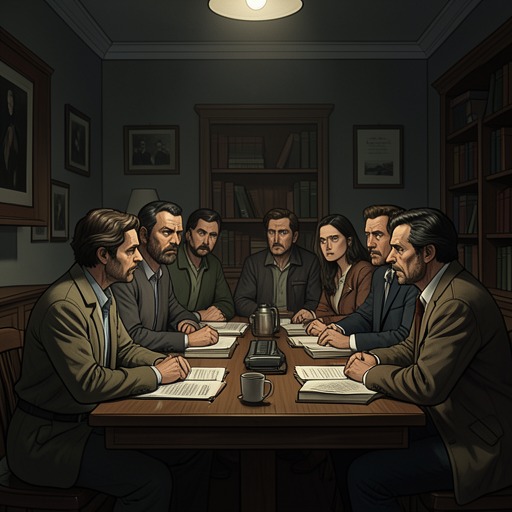
Pierre
Foucault's PendulumPierre, the psychopomp of the Luciferian Church, is one of the decisive figures in the final rite at the Conservatoire. His role shifts from challenging Marchese di Aglie’s control of the proceedings to demanding a human sacrifice and directing the violence that kills Lorenza Pellegrini.
Identity and Role
Pierre appears among the assembled initiates as the psychopomp of the Luciferian Church. In the group’s elaborate hierarchy, his title identifies him with the guidance of souls, while his chest bears a dagger in a gilded sheath in place of the Golden Fleece worn by other participants. That emblem anticipates his practical role in the rite: he is not merely a witness to its pageantry, but an agent who turns its language of sacrifice into action.
The Challenge to Aglie
When Aglie proposes withdrawing with Belbo to question him privately, Pierre interrupts. He argues that Aglie has already spent two days speaking with Belbo without obtaining a response, and insists that the questioning take place before the assembled group. His challenge contests Aglie’s authority to control the prisoner and the secret that the group believes Belbo possesses. The confrontation makes Pierre a spokesman for the collective demand to expose the secret, rather than leave its interpretation in Aglie’s hands.
Aglie then presents Lorenza as the figure who will make Belbo speak. But when that effort fails and Aglie again asks for private access to the prisoner, Pierre rejects the proposal outright. He declares that only a human sacrifice can resolve the impasse and demands Belbo. The insistence marks a turning point: the gathering’s elaborate titles and ritual claims give way to an immediate threat against a captive.
The Sacrifice and Its Consequences
Pierre’s call galvanizes the assembled giants, who seize Belbo and place him beneath the Pendulum. In the ensuing confusion, Pierre takes hold of the moving wire and stops the sphere, helping make the improvised execution possible. His actions are purposeful and consequential: he changes the Pendulum from the rite’s ceremonial center into part of a mechanism for killing Belbo.
Lorenza intervenes, placing herself before Belbo and protesting the group’s actions. Pierre then turns on her, drawing the dagger from its sheath. The narrator’s view is obstructed, so the exact moment of the attack is not seen; the next clear sight is Lorenza fallen at Belbo’s feet, while Pierre raises the blade and proclaims that the human sacrifice has occurred. His declaration makes explicit what the ceremony has become, even as the surrounding crowd surges forward and the rite breaks into disorder.
Narrative Significance
Pierre embodies the point at which the group’s pursuit of an imagined secret becomes physical violence. The participants have treated Belbo’s refusal to disclose anything as proof that he guards a powerful truth; Pierre’s demand for sacrifice converts that circular belief into an action that cannot be undone. His ceremonial office and dagger do not establish supernatural authority: in the decisive scene, his power comes from persuading the group to act and from directly intervening in the execution.
The episode also exposes the gap between the group’s grand ritual language and its human consequences. Pierre speaks in the name of sacrifice, but the result is Lorenza’s death and the collapse of the gathering into chaos. His role is brief, yet it concentrates the novel’s movement from interpretive obsession to violence enacted in the name of a secret that remains undisclosed.